
On 29 March 1978, BBC Radio 4 broadcast the fourth episode of a comedy called The Hitchhiker's Guide to the Galaxy. In it, a giant computer called Deep Thought has spent seven and a half million years working out the Answer to Life, the Universe and Everything. At last it gives its answer, perfectly calm: forty-two.1
Ever since, people have asked: why 42?
The short answer comes first, then the story. The writer, Douglas Adams, chose the number because it was ordinary. Everything since, people added. And a few older 42s turned up on their own, each for its own reason.
The player loads from YouTube (privacy-enhanced mode) only when you press play. Watch it on YouTube.
A number for your parents
We don't have to guess, because Adams told us himself, twice.
In 1985 the original radio scripts came out as a book, with notes. One note says the number was chosen because it was completely ordinary. Adams adds that it is the sort of number "you could, without any fear, introduce to your parents".2
Eight years later, in 1993, a fan on an early internet forum, the Usenet group alt.fan.douglas-adams, asked the question straight out: why 42? Adams answered himself. It was a joke, he said, and any ordinary, smallish number would have done: "I sat at my desk, stared into the garden and thought '42 will do'."3

So the most famous number in modern comedy was picked for being boring. That is the joke. A computer works for millions of years, and the answer is a number you might see on a bus.
Six times nine
Fans still had a reason to dig. Two weeks after the answer, on 12 April 1978, the radio series gave a question to go with it. Arthur Dent, the hero, pulls Scrabble tiles out of a bag at random, hoping the Question is somewhere in his mind. The tiles spell out a question about multiplying six by nine.4
Six times nine is fifty-four, not forty-two. In the story, that is the point. The Earth itself was the computer built to find the Question, and it was destroyed before it finished, so the question came out garbled.4
Then readers noticed something. Count in thirteens instead of tens, and fifty-four is written "42": four thirteens, and two more. Others found more. In binary, 42 is 101010. And in ASCII, the code computers use for letters, character 42 is the asterisk, the star that programmers use to mean "anything".5 So, some fans said, the answer is: whatever you like.
Lovely finds. But in that same 1993 post, Adams waved these theories away in a single line: binary, base thirteen, even Tibetan monks. The answer was the answer because it was ordinary.3
The oldest rule in the book
One theory is harder to shake, and it leads to a much older writer: Lewis Carroll.
At the end of Alice's Adventures in Wonderland, published in 1865, the King of Hearts suddenly reads out a law: "Rule Forty-two. All persons more than a mile high to leave the court." Alice says he has just made it up. "It's the oldest rule in the book," says the King. "Then it ought to be Number One," says Alice.6
Carroll came back to 42 in The Hunting of the Snark, in 1876. The preface mentions a ship's Rule 42: no one shall speak to the Man at the Helm. And the Baker, one of the crew, had forty-two boxes, each with his name painted on it. But he forgot to mention them, so they were all left behind on the beach.7

Some scholars think Carroll had a soft spot for 42.8 And Adams knew his Carroll: he called the radio episodes "Fits", after the sections of the Snark.9 But the 1985 notes take the Carroll question head-on, and the answer is the one Adams always gave: it was simply an ordinary number.2
42s that came first
Long before Adams, 42 turned up in other places too. Each one has its own reason, and none explains another.
Around 1455, in Mainz, Johannes Gutenberg printed his Bible with movable type. It is often called the "42-line Bible", because most of its pages have 42 lines in each column.10 The first pages had forty lines. Then he squeezed more in, most likely to save paper.11
A note, as always on this channel: we look at religious customs through history and culture. We describe what each tradition teaches, with respect, and we don't judge any belief.
In ancient Egypt, Spell 125 of the Book of the Dead describes a judgement after death. The dead person enters the Hall of the Two Truths and speaks to forty-two gods, one at a time, by name. To each one, they declare a wrong they did not do, such as "I have not robbed".12
Egyptologists have often linked the forty-two judges to Egypt's traditional forty-two provinces. In Budge's old translation, some of their names are vivid: one is "Breaker of bones".12
Jewish and Christian scripture have their own 42s. The Book of Numbers lists the places where Israel camped on the way from Egypt, and Jewish tradition counts forty-two stages.13 The medieval commentator Rashi saw God's loving care in it: only forty-two moves in forty years meant the people were not driven from place to place without rest.14
Matthew's Gospel arranges the ancestors of Jesus in three sets of fourteen generations, and three fourteens make forty-two. Counted name by name, the list has forty-one, so one name is counted twice, and scholars explain that in different ways.13
The world joins the joke
After 1978, people started adding 42s as a nod to Adams. Sometimes chance lent a hand.
In 1988, the specification for the TIFF image format said that every file should carry the number 42 near its start. It explained that 42 "was chosen for its deep philosophical significance". Every TIFF file has carried the joke ever since.15
In February 2001, a telescope in New Mexico found a small asteroid. Its catalogue label, given by the usual system of dates and letters, happened to be 2001 DA42: DA, Adams's initials, and his number. Douglas Adams died three months later, in May 2001, and the asteroid now carries his name: 25924 Douglasadams.16
Wikipedia has its own 42. Behind it sits a free database called Wikidata, where every subject gets a number. Item one is the universe. Item two is the Earth. And item forty-two is Douglas Adams.17
By 2003, people had noticed that if you typed "the answer to life the universe and everything" into Google, its calculator answered 42. Some other search tools give the same answer.1819
In 2013, a coding school opened in Paris with no teachers and no fees. Its name is simply "42". One of its founders, Xavier Niel, says the name comes from The Hitchhiker's Guide.2021
The puzzle of three cubes
Then, in 2019, 42 earned a real place in the history of mathematics.
For decades, mathematicians had asked which whole numbers can be made by adding the cubes of three whole numbers. A cube is a number times itself, times itself again, and negative numbers are allowed. Some numbers had been proved impossible. By the summer of 2019, every other number under a hundred had a solution, except one. That last one was 42.22
In September 2019, Andrew Booker at the University of Bristol and Andrew Sutherland at MIT found it. They used more than a million hours of spare time on home computers around the world.22 And they made the joke themselves: Sutherland said they had used "a planetary-scale computer".23

The answer they found:24
42 = (−80538738812075974)³ + 80435758145817515³ + 12602123297335631³
So a computer the size of a planet finally went to work on 42, forty-one years after Deep Thought.
A number given meaning
One of these 42s sums up this whole story better than any other.
On 15 April 1947, Jackie Robinson played his first game for the Brooklyn Dodgers. He broke Major League Baseball's colour line, and he wore number 42.25 There is no record that the number meant anything when he got it.
It means something now, because of him. In 1997, fifty years on, baseball retired 42 for every team.26 And every year on 15 April, everyone in uniform wears 42.27
42 in your pocket
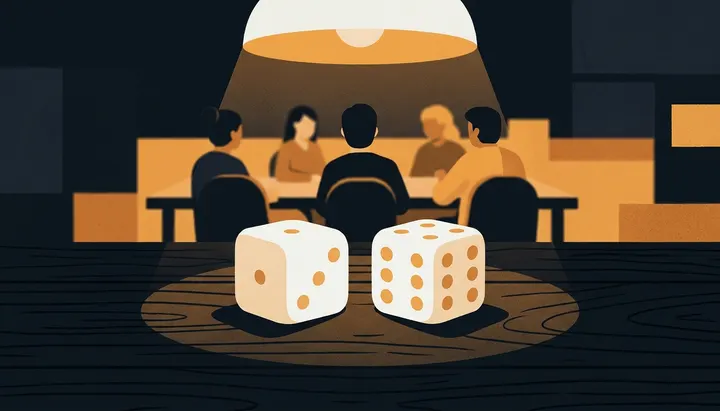
Some 42s are just arithmetic. Add up the dots on a die: one to six makes twenty-one. A pair of dice has forty-two.
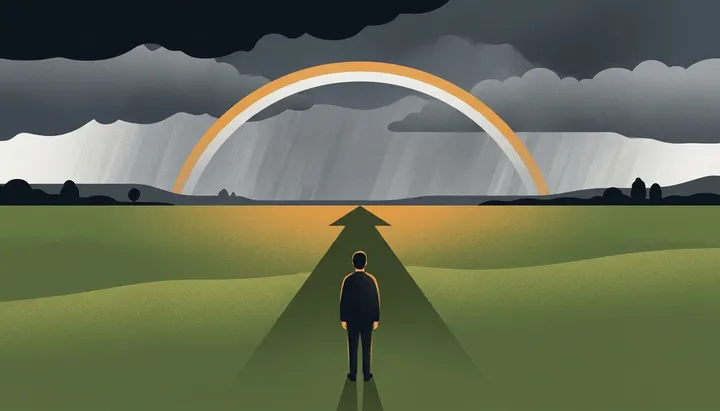
Next time you see a rainbow, look for the shadow of your own head. The bow always stands about 42 degrees out from it, all the way round. Descartes explained why in 1637, with light passing through raindrops.28
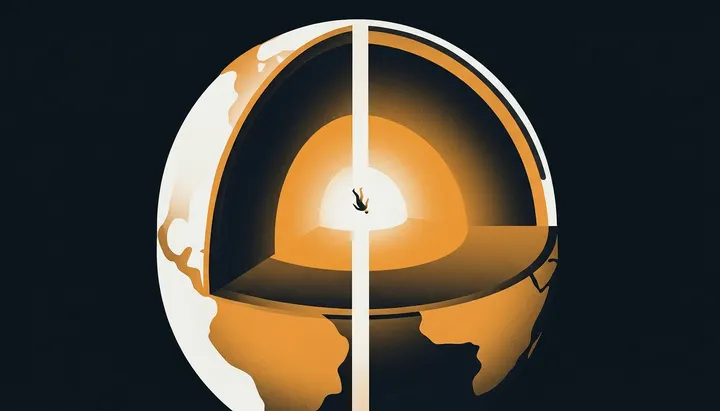
And there is a textbook puzzle: drill a straight tunnel through the middle of the Earth and jump in. With no air, the classic answer is that you come out the other side in about 42 minutes.29 The real Earth, with its heavy core, makes it nearer thirty-eight.30
So, why 42?
Because Douglas Adams wanted an ordinary number, nothing special. He looked out at his garden and picked one.
Everything since came from us: fans, programmers, astronomers and mathematicians. And the older 42s, from Gutenberg's lines to a pair of dice, each came about for its own reason. A number doesn't need a mystery behind it to matter. People give it meaning.
Where have you spotted a 42? Tell us in the comments under the video on YouTube.